v.. To move a tall, flat bottomed object (such as a bookshelf) by swiveling it alternatively on its corners in a "walking" fashion. [After the book by Thor Heyerdahl theorizing the statues of Easter Island were moved in this fashion.] source: LangMaker.com. Aku Aku also has another meaning: a spiritual guide.
There's a little dive pub (turns out actually not a dive anymore) I'd been meaning to go to for years, and finally stopped by a couple of weeks back. I love checking out the old San Francisco spots that persist through the decades and ha...
One of my favorite jobs was a consulting gig I did between when my co-founder and I realized we were running low on cash and were not going to be able to raise the funds we needed to grow our two person startup Meexo (most investors didn't believe people would use smart phones for dating in 2011), and when my co-founder got us acqui-hired by Live Nation (for enough money to pay back our investors' convertible note and pocket a little for ourselves, he's really good). Anyhow, the main reason I liked that gig was the people. They were just a great bunch to hang out with, and their product was visionary and interesting as well. I was only there for ~6 months before I ended up at Live Nation, and soon after they also got acquired by Yahoo.
Their product was an iPhone app that functioned as kind of an expert system personal assistant. It could hook into your calendar, your contacts, use location services to help you get to your next meeting, that kind of thing. The CEO was a highly thought of designer (and not just pixels, but UX chops too) so the product was beautiful and a joy to interact with. The small founding product/engineering team was also bunch of accomplished talented people. Notably several were from the early Netscape days. These people helped make history already, so I was pretty happy to be rubbing elbows with them. Every single one was a particular joy to spend time with in their own way.
One of my first tasks was to help overhaul the bespoke windowing system one of these founding engineers had created. At the time, Apple had an official SDK for creating iPhone apps including a windowing system called UIKit. Rather than learn this new system, he had taken an old windowing system he had previously created on a different operating system in a different language, and ported it to the iPhone's operating system in Objective-C. The problem with this non-standard approach (I think it was called something-Box, let's call it DBox) was that he was the only person who really knew how DBox worked. If they were going to grow and hire more iOS engineers, either they would all have to learn DBox or the app would need to be refactored to use the Apple's standard UIKit system. Switching to the standard system not only would make the new engineers more productive, but comes with all the other benefits of using a broadly used and official approach: easier to hire experts at it, continued improvements by Apple, etc.
So I rolled up my sleeves and got to work figuring out how to convert to UIKit. At this point the app was already quite built out with many screens filed with text, buttons, images, animations ... and all of it was some component of DBox. It took a few days of studying the system but I started to get an idea of how DBox worked. It wasn't easy because compared to UIKit which was built by a team at Apple and battle tested across thousands of apps, DBox was limited, bare bones and a bit more difficult in general.
One day at our morning standup, where the team gathered to update each other about the things we were working on, rather than jump into technical details I said something along these lines:
Back in the early 80s I subscribed to Dragon Magazine, a monthly periodical for Dungeons & Dragons nerds. It was mostly filled with game-specific articles but it also often featured a short fiction story. One in particular that always stuck with me was about a person who entered a massive dark evil forest for reasons unknown.
If you want to read this very short story for yourself first, issue #54 is available on the Internet Archive (here). It's on page 49. Scroll down past this image of the cover to continue with my recollection of the story.
This was a gnarled woods that few dared to enter, and none had came back out. Everywhere and everything in this forest was corrupt and trying to kill the person from animals and poison plants to treacherous passages, but they trudged deeper and deeper until they reached the very heart of the forest. When they reached the very center, exhausted and bruised, they opened a pouch and drew from it a single seed. This person was a druid, a wizard of the natural living world. They planted that seed in this deepest depth of this forlorn forest and began to chant spells of growth and protection causing that seed to grow into a massive and powerful conduit of Good in the center of the Evil wood, and as they continued the Good spread outward relieving the surrounding flora and fauna of their malevolent enchantment until the whole forest was free and wonderful. Yesterday, I concluded, I replaced a DBox button in our main screen with a UIButton.
LOLz. This morning I woke up thinking about that story again, probably because I am once again working for someone from that team and decided to try to see if it was online. I did some searching on DuckDuckGo but nothing was really turning up. There is a comprehensive list of all the short fiction ever published in Dragon Magazine, but none of the titles rang a bell. The indefatigable Internet Archive of course has every issue of Dragon Magazine available for download as PDF (other than the one featuring the lone George R.R. Martin story of course :eyeroll:). I knew the story had to be from the late 70s / early 80s so I started poking around to figure out where that started and decided to download issues 40-99 and search through them. I downloaded a couple through the IA web interface, noted that the URL of the PDF was standardized, so I wrote a quick ruby script:
(40..99).each do |i| puts i `wget https://archive.org/download/DragonMagazine260_201801/DragonMagazine0#{i}.pdf` sleep 0.25 # just a good habit end
Then I converted all the PDFs to easily searchable text:
find . -name "*.pdf" -exec pdftotext {} \;
And finally, grepped the .txt files for something I could remember from the story. "Druid" turned out to be too many hits, but "seed" was only 20 or so, and it was quickly obvious that the usage in issue #54 was from a story. It took about 20 minutes from waking up thinking about this story to being able to find it and read it again for the first time in ~40 years. That's a great way to start the day! The story is as powerful as I remembered, although I had forgotten important bits, particularly that it is told from the point of view of the wilderness itself. Also that the druid was a half-elf, which was always my choice of character to play in AD&D since I was a half-Asian half-Caucasian myself.
Besides the hapa-based identification with the hero why has this story stuck with me all these years? The month this issue came out, I turned 14 years old. I was a poor-not-white-enough-trash kid growing up deep in the actual woods of North Carolina. My home life with my retired Marine Corps alcoholic adoptive father was physically and emotionally abusive. I was bullied at school by racists (both white and black). We lived pretty far from other houses, surrounded mostly by a forest owned by the local paper mill and I spent a lot of time alone by myself venturing into the woods with my dogs, playing adventurer. I didn't feel powerful though, and was troubled with my own burdens of anger. I didn't feel I could change things although I desperately wanted to.
At 14 1/2 I started working as a dishwasher, and made enough to buy a Commodore 64. Coding became the new forest to explore. Christmas of 1982 my mother bought me a 300 baud modem and I've been online ever since; it took the rest of the world almost two decades to catch up. Somewhere along the line in this digital online world I started to live, as the short story ends, "for life and not hate, free to have good with my evil and calm with my violence."
A friend who was looking for a new job texted me "how does one become a demonstrably better engineer?"
Given what I knew of their context, I assumed they were looking for something actionable that would ratchet them up a notch in interviews (perceived more senior). The question stumped me. I just didn't have a good answer. Given the longstanding situation where companies interview in a manner optimized for the software engineering challenges of last century, there are only two ways I really know of that typically manner: be recruited directly by ex-colleagues who know your skills well, or excel at those wrongly optimized tech interview shenanigans. Sometimes the timing is off for the former to work.The problem with the latter is that the longer you spend actually doing typical 21st century engineering work, the less you remember how to pass those useless puzzles that rarely come up in real work (and when they do, are more quickly and reliably solved by doing a litle research rather than trying to implement something from 30 minutes at a white board).
It stumped me so much, I didn't reply for a few days while I mulled it over. Then I went on vacation for a couple of weeks, feeling guiltier every time I remembered I still didn't have an answer.
Procrastination is like a credit card: it's a lot of fun until you get the bill. - Christopher Parker
I've spent a couple of decades hiring engineers off and on. Most of that time I've conducted the exact same pair programming interview, but that would be a whole other post and not likely to be relative to my friend's interviews. I considered how I would start to believe someone was a senior level engineer in the absence of my usual rubric.
I still don't have a great answer but I do have a couple of thoughts.
1) I believe that the best software engineers are like blacksmiths.
Both blacksmiths and software engineers make their own tools. The tools they use on the job are made of the same stuff they produce, so a master of the craft should be comfortable doing this. Making your own tools demonstrates not only that you understand how to do basic tasks for your job, but you probably also understand which tasks are the most important to the overall goals, and have creative thoughts about how the approach to those tasks could be improved. So one way to demonstrate your skills are to be able to talk about the tools you have made and how they helped you and/or your colleagues reach team goals better.
Maybe you automated a tedious task that used to waste time and/or allow human error to creep in.
Maybe you extracted data on your processes and built a report to show where bottlenecks lie.
Maybe you built a tool to visualize your app logs in a richer way, allowing issues to be found quicker.
Maybe you extracted code to a sharable package so that it could be shared by system components.
Maybe you developed an IDE plugin that improved support for a custom part of your system.
I believe conversation about tools you've built reveal a lot about how an engineer thinks and can highlight the skills with which you feel comfortable. It can also be interesting to discuss the tools you didn't build and why.
2) Have a portfolio
One of the major problems with demonstrating your skill at interviews, is that probably all that great code you've written for past employers is closed source and unavailable to show. One solution to this is to have contributed to open source projects. Not everyone has time to start and maintain their own meaningful Open Source Software project, or even to make significant contributions to one, but just like the professional artists' need to maintain a public portfolio, there is a benefit to having something on Github you can point to and talk about.
I don't plan on ever being a hiring manager again, but if I were I would consider the following as an addition to my usual pair programming exercise: ask the interviewee to be prepared to talk about a few contributions they made to OSS projects. It could be simply finding open Issues in an existing project and submitting a PR for it. Some things that might be interesting to discuss:
Why did they choose the project?
How did they communicate with existing contributors? (if the communication was public on Github, walk me through it)
Why do they think the Issue had not already been resolved?
What approaches did they consider in implementation? Why did they decide on the one that they did?
What tests did they add to ensure their implementation was correct?
How did they handle PR feedback?
There are similar opportunities to have something in the OSS ecosystem without even contributing shipping code:
They could pick a project with a lot of open PRs and in a technology they know well and simply code review them. In fact, given modern prevalence of code reviews, I think this would be a great thing to demonstrate to an interviewer.
They could contribute tests to low code coverage projects. It's an even better story if these tests exposed previously unknown bugs!
They could contribute failing tests that highlight an open Issue.
Obviously the interviewee could cherry pick their best OSS contribution narratives to demonstrate, but as an interviewer I would value recency so even if you have a great story to tell and show from years back, I would still put a little time into having one or two recent examples as well.
I haven't spent a lot of time in Roblox, even though both of my kids have spent significant amounts of their time and my money there, but this essay about how it compares to those places where teenagers hang out and create their own space away from the rest of the world really resonates. It makes me want to give it a try again.
Some choice excerpts:
On his first experience in Roblox:
In one of the very first games we played together (a work-in-progress safari game, the link to which I have since lost), V became a zebra, and I was a lioness. We ran around a broad plain populated by other animals, trees in the distance, low clouds overhead, and the buzzing of insects on a 2-minute loop. The chat was full of messages from prey to prey, predator to predator. V was almost immediately killed by a cheetah who then got in the chat to say, “Overyone come to pr,” “theres meat.” Summoned, I did so, and as I ate the still-living digital body of my friend in the company of a stranger in the shape of a wild dog, I thought, “Oh. This is special.”
On the game creation tools:
But perhaps the most interesting thing about Roblox Studio is the Toolbox. Other game engines have assets stores, but none of them feel like this: a rollicking, copyright-fucked, messy, virus-filled, unsortable pile of labor and of love.
On the long tail of forgotten worlds (games) waiting to be stumbled upon:
But the things I am making in Roblox are not what are unique or compelling about Roblox, and the same could be said for most of the big games that populate the platform’s front page. Instead, what is so special here are the millions of bizarre little worlds, all networked together and waiting (mostly empty, sometimes for over a decade) to be dropped into and explored with friends.
As a developer, you can monetize your own games in a variety of ways, from the above-board (tip jars! cosmetics!) to the scammy. Developers earn 70% of Robux spent in their games, which is a pretty standard cut for an app store/developer split. However, getting USD back out of Robux is a different story. The payout exchange rate drops to $0.0035 USD per 1 Robux, meaning the takeaway in real world currency is roughly 24.5% of any in-game commerce—a brutally extractive exchange rate.
The Singularity Summit is an annual event put on by the Singularity Institute ("bring[ing] rational analysis and rational strategy to the challenges facing humanity as we develop cognitive technologies that will exceed the current upper bounds on human intelligence"). In a nutshell, it can be rationally conceived that in humanity's near future artificial intelligence will be created that is smarter than us, and after that, all bets are off, hence the "singularity". You might say to yourself, just like surely there are some scientists making sure we don't get hit by a giant asteroid or that some bioweapon doesn't decimate the planet, surely there are some scientists or policy thinkers out there who are considering that and preparing for it, just in case, to make sure we don't end up in some Terminator-esque dystopia. These are those scientists and thinkers.
I should note upfront that this sort of serious exercise in long term thinking with a bent toward fantastic extreme technological possibilities attracts a certain kind of sci-fi nut type, and just like the naked people at burning man, they seem disproportionately represented in the image outsiders have of the group. So yeah, there is some of that, at all levels of the community really, but in general there is good rational thought going on.
The following is my brief recap of the event. I didn't actually take notes the first day, so my recollections can be a bit sparse there. Apparently the videos will be online later, I'll update with links then. I tried to spell check this but the system failed to work, so I apologize in advance.
Ray Kurzweil “From Eliza to Watson to Passing the Turing Test”
If the Singularity has a poster child, it is Kurzweil. He wrote the book on it and, I think, founded the Singularity Institute. I've seen him talk several times (I was even on his diet for awhile). His intro was fresh compared to often rehashed slides and points, but honestly I don't remember much of it. The basic message was that things are on track with recent events holding to earlier projections. He still puts 2029 as the target date for the Singularity. The thing I overheard people recounting from his talk most often was the concept that as one advancing paradigm of technology runs out, another seems to take its place. As in when vaccuuum tubes hit a physical laws wall, the transistor was forced to appear, as flat transistors reach the end of their run, we'll have 3D circuits (already 30% of memory chips are 3D (I think, this is from memory, heh)). This is a convenient concept for hand waving purposes, but convenience doesn't mean it's wrong, so ok I buy it.
Stephen Badylak: “Regenerative Medicine: Possibilities and Potential”
This was a remarkable presentation on the recent advancements in regenerative medicine. He demonstrates how new trials on humans have successfully regrown parts of humans that previously medicine had no way of repairing. The technique consists of grafting on an "extracellular matrix" (from a pig) onto wounded human meat. The matrix attracts endogenous stem cells from the patient to the wound site, which starts an amazing repair process. He showed this technique successfully being used on a soldier with massive loss of thigh muscle from a roadside bomb and a man with throat cancer.
Peter Thiel: “Back to the Future”
Thiel is an impressive guy, part of the impressive PayPal Mafia. His talk had lots of little pithy quotes, some of them are at Gubatron.com. Here's one more (paraphrased) the less privacy we have as a society, the more tolerance we need. I'm willing to trade off privacy for social tolerance.
Sonia Arrison: “100 Plus: How the Coming Age of Longevity Will Change Everything, From Careers and Relationships to Family and Faith”
Arrison, recently on TechCrunch TV, is pitching her new book where she muses not so much on how we are going to increase life expectancy in the US from 80 to 150 years, but what the implications are when we do it. It seems to be a light treatment of the subject, but an interesting starting point. And since it's inherently speculative, how deep can it reasonably go? The Thiel Foundation was giving them out for free so I got a copy.
James McLurkin: “The Future of Robotics is Swarms: Why a Thousand Robots are Better Than One”
This was very cool. Autonomous swarm robots, what's not to like? Robots swarming earthquake rubble, oil spills and and other planets ...the usual stuff. His main point seemed to be the research his team has done into how to do command and control of such artificial organisms. The idea is to have some of the bots take a internal scaffolding/skeletal role, others to understand that they are the edge role and workers in between. Also he was pimping his new affordable robot he wants to disseminate all over the world.
Michael Shermer: “Social Singularity: Transitioning from Civilization 1.0 to 2.0”
Shermer is an impressive thinker, an editor of Reason magazine and frequent talking head in debates on theological issues. He gave homage to one of my favorite books, Robin Wright's Nonzero, and basically takes his thesis (as I remember it from lack of notes) from there, which is that civilization will continue it's path toward becoming one big love fest because the arc of the moral universe bends toward justice (paraphrase of Theodore Parker).
If you get time, you might want to watch this 80 minute talk Shermer gave in NY recently on the subject of "The Believing Brain", his recent book.
Jason Silva: “'The Undivided Mind' — Science and Imagination”
Silva thinks that the those of us concerned with the singularity should adopt more sexy, populist modes of communication in order to instigate public awareness and debate on the subject. Either that or he wants us to tune in, turn on and drop acid. Look, I'm all for psychedelic-induced thought experiments as a way to broaden the mind of the individual, and by safe proxy, humanity. Hey it worked for Francis Crick when he came up with the breakthrough idea of perhaps the most important discovery of the 20th century. However the message on the benefits of mind expansion is better delivered by John Perry Barlow than this guy, who comes off as a tripped-out name-dropping trust-fund jet-setting raver-kid. I completely agree with his premise to an extent, but he takes it way too far. Frankly he reminds me of friends of mine, I'm sure I'd enjoy hanging out with him. But I wouldn't want any of these friends being the creative director behind Singularity awareness either. Check this out:
Less of that, please. It's like what David Brin talks about later. If you're trying to get a message through to people who are skeptical, you need to be very careful in how you explain your positions. You need to speak their language, not yours. This sort of message is just going to scare away the people we most need to convince.
This is a problem that goes all the way to the "top" for that matter. The recent documentary-slash-narrative film on the singularity starring Ray Kurzweil's beautiful female virtual avatar Ramona in the narrative role was also not the right way to convince people to take this stuff seriously. It was an interesting thought exercise for those who are already predisposed for this stuff, but it's not the way to recruit rational but unconvinced people. Oh, huh. Maybe that's what I'm not getting. Maybe they don't care about recruiting rational thinkers at this point?
Incidentally it's the same problem with the Occupy Wall Street movement. As long as the people representing the movement are the type most of America consider to be slackers, the movement is constrained.
Stephen Wolfram: “Computation and the Future of Mankind”
I am terribly embarrassed to admit this, but it was right after lunch and I haven't been getting enough sleep lately. I fell asleep through half of this. But the latter portion I was awake for was quite good. I'm looking forward to the video being posted so I can catch up with it. He was going over his New Kind of Science material and his WolframAlpha work. It was interesting but being groggy and not taking notes I'm hard pressed to relate it now. What I grokked for the first time was that his impetus for starting down the path of a New Kind of Science was the thought that if it seems possible that the entire universe can be reduced down to a simple computation then we ought to have a few scientists looking for that computation. Just like we have a few looking for the big asteroids or the origins of the universe. It's not a practical thing in a day to day sense really, but heck someone should be looking for it. He started looking.
Between my sleepiness, his accent, the bizarre material and him losing his notes for a couple of minutes, I got up and went looking for caffeine. It had something to do with sexbots I think. Check it out here (actual URL): http://2045.com/(cool/
Christof Koch: “The Neurobiology and Mathematics of Consciousness”
But made it back in time for a wonderfully nerdy talk on consciousness. Koch and colleagues have worked out an equation that can be used to (possibly, it's still being tested) determine whether or not someone is conscious. It is founded on two observations.
Consciousness is a highly differentiated state
Consciousness is highly integrated
Using this basis, they developed a technique to calculate a value phi, Φ, that quantitatively measures consciousness. You can read all the details at Scientific American or download this pdf.
Eliezer Yudkowsky: “Open Problems in Friendly Artificial Intelligence”
Oh this was soooo awesome. I only grasped probably 1/3 of it, if that much. But I think it was all accessible with a little more time to process it. I'm probably going to rewatch this video several times.
Yudkowsky explains the logical problems with depending on self-modifying artifical intelligence to check itself such that it's modifications never violate previous rules it held. In other words how to keep friendly AI's friendly. There was a lot of logical notation, Godel and Bayes mixed in there. I'm not going to try to recap this because I didn't grok enough of it. But I found a paper that he wrote on friendly AI's.
I'm pretty sure I saw him speak at the Singularity Summit 2007 as well, here's a video from that talk:
Max Tegmark: “The Future of Life: a Cosmic Perspective”
This was a nice way to end the day. The bulk of the talk centers around his argument that we ARE alone in the universe, or we better hope we are. Using what looked like an awesome application called Deep Space Explorer he puts our place in the universe into perspective. Check it out below. It's a long video but in the talk for about 20 seconds he used the app to zoom out from earth to the solar system to the sub galaxy neighborhood to the whole galaxy, etc. All 3D and rotatable. The point is we might as well be a pebble in the ocean.
He then goes on to explain the problem with Drake's Equation which famously computes the probablity of there being non-Earth life in the universe. He believes the issue is with the terms that represent the fraction of planets that can support life, do support life and eventually support intelligent life. Those probablities can be incredibly low. There could be some step in the process in becoming a extra-planetary intelligence that is very difficult to complete. And we better hope that the difficult step is before the stage we have reached (so we have already passed it) rather than after it. Otherwise we still have a big hurdle to clear.
Alexander Wissner-Gross "Planetary Scale Intelligence"
How could a globe-spanning AI come about? Well, who is most incentivized to create it?
Quantitative Finance, which has a goal of modeling human group behavior in the markets in order to efficiently allocation capital.
Quantitative Advertising which is concerned with modelling the human mind to engineer better ways to sell to them.
He believes Quantitative Finance is most advanced and most economically coupled to humans so this is most likley what will drive it.
Right now stock exchanges are being rebuilt around low latency, causing incredible new networks to be built. Finance is driving us to the limits set by special relativity for passing information around the planet.
He believes that the logical physical placement of the distributed AI nodes can be determined by plotting the midpoints between the the worlds stock markets. He even shows the map of this, where most nodes are going to be in the middle of the oceans. Coordination will drive the AI.
The red dots are the stock markets, the blue points the midpoints:
He closes with why he believes Quantitative Finance is a blueprint for management of the singularity, where he lists how existing mechanisms will map to the ones needed for humans to control globe spanning super intellgent AIs.
pre-trade algorithm testing -> source and binary audits
Dark pools -> Vinge's "zones of thought"
"Large trader" rule -> detailed registry of AIs with government, including human org charts
Market circuit breakers -> Centralized ability to cut off AIs from outside world.
Swap data repos (black box recording) -> Centralized AI activity recording
Short term cap gains tax -> Tax or throttle AI bandwidth to outside physical and digital world
I emailed him these two questions, but no answer yet:
The chart at the end nicely shows how existing systems can lead to appropriate AGI mechanisms. Are there any necessary AGI regulatory mechanisms that you don't see coming from existing Quantitative Finance systems?
I don't know much about Quantitive Finance, but as I see it seem to take over more and more of the volume of trading, won't the impetus change, at some point in time perhaps pre-AGI, from modeling human behavior to modeling other Quant Algorithm behaviors?
Sharon Bertsch McGrayne: “A History of Bayes' Theorem”
As a bit of a math history nerd, this was interesting for 15 minutes. But she started to lose me pretty quickly. Off the rails in the end when she was unable to articulate what the Bayes Theorem is. Nice lady, I'm sure, but poor choice of presenter for this summit. I'm sure half the audience understood more about Bayes Theorem than she did. She should have been upfront about not really understanding it, but having researched some interesting anecdotes related to its history and usage. Then the Q&A session would not have been so awfully painful.
David Brin: “So you want to make gods. Now why would that bother anybody?”
In this light humorous presentation, Brin proposes to teach Singularity thinkers how to talk to religious skeptics. Points out that the Great Silence (no ET communication) may be due to "the grouches always win." Or in other words, the science haters stop progress. Rational thought is under attack, we need to "consider Judo." Speak the language, use the bible to draw them toward the light.
I didn't jot down or retain too many of these, although I agree with his central thesis. Here's a couple:
"Naming things" in Genesis is the only part of the bible that talks about what God intended humans to do before they screwed up and were cast out of Eden. It is the only pure moment of the bible that is evidence of what we were for. God wanted us to name things, and what is naming things but science?
The "cut them off at the knees" argument: The story of Jonah shows that God can change his mind. This won't probably win any arguments but it definitiely is a left hook they won't be expecting you to know how to throw.
Cowen was very articulate and exhibited a rational thought process that I find refreshing. Here's my loose notes. He says we are approaching a time where over specialization is making it so regular people can't understand modern science. Because of financial incentives, a lot more human talent is going into ripping each other off rather than advancing humanity as a whole.
We couldn't build today's energy infrastructure from scratch with today's regulations.
He had a depressing slide on "Total Factor Productivity" which shows growth of national revenue based on novel ideas. It has totally leveled off over the past 30-40 years. We grow GDP through lots of tricky ways, but actual growth due to innovation has plateued.
Science is losing it's ability to attract popular opinion. It has ceased to tell a compelling story of the future.
In 2030 the US population demographics will resemble the current population of Florida.
The oil shock of the 70s caused the Stagnation, like the argument that leads to a romantic break up it's not the real reason for the collapse, but it brought all the real problems to bear.
The primary failing of financial innovation is the inability to monitor and gauge risk (as opposed to monetary policy like going off the gold standard).
You can hear him talk about it all in this 18 minute TED talk:
Tyler Cowen & Michael Vassar Debate The Great Stagnation
Vassar comes out looking like a Monty Python sendup of an intellectual. Sort of hilarious in his overdone sombre demeanor and attire, followed by an incomprehensible joke that "falls flat." He seems immediately outclassed. The debate, frankly, was better between Cowen and the audience. The only part I tuned into was when Cowen asks about the possibility of having an AI that can help you date, since that's pretty much what I'm building right now.
John Mauldin: “The Endgame Meets The Millennium Wave — Why the Economic Crisis will be History as We Create the Future”
Cringe! OMG. A creepy infomercial guy has invaded the stage! WTF. Who let this guy in? Oh, he's in some adoption cult. It must have been some inter-cult loan system like Link+ for crackpots. My bullshit active-defense filter sprung up too quick for me to hear any of this talk. Honestly I may even agree with whatever he was selling, but his delivery was just as bad, in a different but even less palatable way, as Jason Silva's. I spent most of the talk watching the two camera operators at far ends of the stage use hand signals to coordinate their efforts.
I found a video of him doing what is likely the same talk. Clicking through it quickly, it seems like his delivery isn't nearly as "snake oil salesman / evangelical preacher" in this one, so maybe I'll make time to get through this one:
Riley Crane: “Rethinking Communication”
How can we use new communication tools to engage people in new ways and further a cause, like the cause of science? He takes his physics research on how large groups of electrons organize and uses it in understanding how human systems organize. He found a lot of regularity in how social media is disseminated through society. I believe he related it to the Poisson average. He showed how people have observed a statistical fingerprint that describes procrastination in a study of how long it took Einstein and Darwin to respond to letters. People have behavior patterns.
To get large groups of people to do thing you are fighting the economics of attention.
Wisdom of crowds is great. But not all problems can be solved by aggreagation. Some problems require coordination or collaboration.
For example, in winning the DARPA Balloon Challenge, they concocted a number of smart virality tricks to assemble a vast network, but there was some sabotouge. Data cleaning helped some, but additional tricks were required (which he didn't have time to go into). The primary lesson from this seemed to be: Incentives drive participation. Don't tell the rabid viral marketers, they don't need any more incentive to annoy us.
He talks about of a third type of tie (Strong Ties/Weak Ties) that is need to be understood: Temporary Ties based on temporary contexts.
Ultimately, shaping behavior is about Attention, Incentives, Communication.
Dileep George and Scott Brown: “From Planes to Brains: Building AI the Wright Way”
This was a tag-team from the folks at Vicarious Systems, a team that grew out of Numenta the company founded by Jef Hawkins and his theories outlined in On Intelligence.
The mammalian brain can do some amazing searches of possibility space in a short span of time. This ultimately indicates the neocortex has a lot of built-in assumptions via evolution. In working on AI, instead of "what are the algorithms" we should ask "what are the assumptions?" We can look at the neo-cortex for hierarchical structure that matches physical world hierarchies. This could indicate efficiency and re-use in data processing. Just as it is not necessary for an airplane to flap its wings to fly, it's not necessary to mimic the brain to be intelligent. So they use non-biologically-inspired logic in their AI system. They were able to (I think) in-line some non-bilogical logic and map it back to a biological circuit. He had some reasoning why they had to start with a vision system for his AI, but I didn't really get it. Something about connection to a Perception-Action system.
Jaan Tallinn: “Balancing the Trichotomy: Individual vs. Society vs. Universe”
Starts the talk with a story about Stanislav Petrov, the guy who literally saved the world in 1983 by not following protocol and launching a soviet nuclear counter-attack to a false alarm.
For a long time, society didn't change much and the recipes for dealing with challenges were firmly embedded in culture. Our environment is changing so fast that society is no longer as equipped to deal with challenges as are individuals. There was something else here about "Future Society" that I missed.
Evolution has played a trick on us that keeps us from doing long term thinking. the trick is the Social Status Reinforcement Cycle, a reward system we are addicted to. It causes us to focus on short term results, have scale insensitivity, and do things that are easy to understand. If we attempt otherwise, we likely are not going to get the social status reward we crave.
His thoughts (and financial freedom due to selling Skype) to pursue solutions to this problem led him to want to help solve problems in the existential domain, as in the existence of our species, which led him to wanting to help determine how to make an AGI "do what we want." To that end he has donated money, involved himself in the research, and use his "street cred" to evangalise the work.
He proposes long term thinkers brand themselves as the CL3 Generation where Level 3 denotes not thinking abou the self, the immediate society, but the future society. One interesting thing is a suggested fund, which he would like to call the Petrov Fund that pays out in hindsight to those who have donated meaningful effort to solving long term problems.
By the way, there is already a Petrov Fund run by a woman in San Francisco. It's a 501(c)3 non-profit that accepts donations on behalf of the real Petrov who was fired from his job and living near poverty level in Russia.
David Ferrucci: “Watson AI Perceptions”
I'm not even going to try to summarize this wave of information on how the built IBM's DeepQA Watson supercomputer beat the pants off of the top human challengers. The key point was that they generated a set of answers with confidence values and a minimum threshold to buzz in. It was awesome. Thick with operational details. Looking forward to re-watching thisone as well.
Here, watch the results of a practice round, note in the last half you can see the answer sets on the monitor:
Dan Cerutti: “Commercializing Watson”
How to determine what to do with Watson now? Start with what Watson can do:
It understands human language. That's a big deal.
It can read near limitless content and never forget it
It returns quantitatively confidence based answers
Given training, it learns
and four orthogonal issues
It takes a long time for the tech to mature, so it's a serious choice to decide where to start
Need to find high value problems
Need to work on problems where solutions are generalizable or scales
Needs to be something that matters.
Suggestions:
Finanance companies want to know what stocks to buy. Dan quipped "I'm not sure I'd sell that technology"
Applications in legal analysis.
Things that made sense to the IBM team were defense applications and education, but they realized it is better for important, critical decisions that are made by human beings, many times per day, quickly, where there is a big gap between what is available and how quickly a human can digest it. They decided to focus on health care.
Hell yeah. Go Big Blue!
Ken Jennings: “The Human Brain in Jeopardy: Computers That 'Think'”
A crowd-pleasing closer where Jennings, the biggest winner in the history of Jeopardy, talks about his experience losing to a computer. Full of jokes about how Watson doesn't have to pee, and how it was like "an away game for humanity."
"This is what it looks like when the machines come for you"
My wrap up
All in all, a very good conference. There were two nude women slides and a cleavage shot during the presentations, no male sexuality exploited, so it scored mediocre on the sexist scale. It did better than mediocre on the no-crackpot scale, with maybe only 1 or 2 violators.
Next year it will be in San Francisco again so I will most likely return.
I do wish they had more structured opportunity to meet other attendees. One nightime activity would be nice. Some sort of official back channel (other than twitter) like tossing up an irc channel or setting up something on a mobile group app. An attendee wiki or forum even.
Turntable.fm may turn out to have pulled the most epic Odeo since Twitter. Despite serious problems with stability, the service has practically erupted in users with average engagement times that surely beat out even Facebook. I'm not going to bother typing up a description of the service as it is ably described here at Signal News, and I'm thinking of writing a more in depth analysis of their engagement mechanics (based on Amy Jo Kim's Smart Gamification patterns), but here is a brain dump:
As my friend Todd Siegel pointed out, at a basic level SecondLife has been offering something similar for years. In fact they go one better by being optimized for presenting actual live performances and not just playing mp3s and they offer better avatars and servers that stay running. Why didn't SecondLife hit the same engagement lottery payoff? This is an obvious lesson in keeping it simple and focused. SecondLife is far too complex and although you could pull off the tt.fm experience easily in that environment it would
be harder for listeners to discover "rooms" and learn how to use their more expressive and customizable but more complicated avatars.
require an external system for managing the audio stream, as uploading audio files to SecondLife is costly, but it is cheap/free to play a stream hosted at an external source.
The Record Labels: Obviously the tt.fm team has tried to address their concerns by adding things like the inability to hear songs you are playing unless there is at least one other DJ on the stand. So although you can upload music, and add the music that others have uploaded to your playlist, you can't just go and treat it as your personal jukebox. You have to collaboratively be creating a de facto Internet radio station. So hopefully this lets them use the same terms as sites such as Pandora or Last.FM. The RIAA does not have a good track record for being smart, but they should really wake up to the opportunity here. I've not only bought music already that I discovered at tt.fm, but I've even bought tracks in iTunes just to add them to my tt.fm playlist! This is the most engaging music offering I've seen since Napster, and unlike Napster this one has clear ways for the RIAA to get their fair share of the pie. Heck the user song-engagement data they are collecting alone should be of great value to the record labels (think along the lines of what Chris Sacca descrbes about Twitter in his Kevin Rose interview).
The Wishlist, aka Things I Would Have Probably Spent Tens of Dollars On Already If Available:
Purchase DJ points, so people won't resort to things like AutoBop and the like.
Multiple Playlists. Nothing is more embarrassing than not noticing that you've run through all your punk songs at the top of the queue and push into the psy-trance territory.
Custom Avatars. I should be able to upload my own PNGs. Oh what I would have paid for that already.
Room options that can be set by the moderator(s) such as genre (enforceable by id3 tags), a queue for lining up to take open DJ spots, number of songs per DJ before they have to step down (maybe a function of how many DJs in the audience are queued up).
Plugin API for writing bots for specific rooms. For example, I hang out sometimes in a room where we invented a game (I call it Turn Robin). The rule is that when you play a song, it has to contain at least one word that was in the last song played. This is fun since whn you are the next DJ in the round-robin queue then you have a limited amount of time (the length of the song currently playing) to find a match so there is some pressure to perform, the resulting song mix is wonderfully eclectic and there have been some great transitions. It would be nice if we could just code a bot to run as the room moderator and enforce the rules by doing string comparison on the successive tracks. If a DJ fails they would get forced to give up their spot (and next DJ in audience queue could jump in to play perhaps).
It would be nice to have an HTTP API as well so we could have things like:
Growl integration
Desktop app to let us participate outside of the browser (which would help restore productivity in many offices). I'd like to see the current song/dj up in my OS X status bar, for example, with the Awesome/Lame buttons always available there.
Mobile app! I sometimes put turntable.fm on the tv/stereo in my living room. It would be nice to not have to get up and go to the MacMini connected to the TV in order to participate, I (and my guests on their own phones) should be able to do it from across the room.
A turntable.fm screensaver that mixes with Last.FM to show current artist photos, etc (actually I just want that for Last.FM stations even).
Audio level normalization. This comes up more often in the old school punk rooms, but a lot of tracks for whatever reason are mastered at a lower volume. I'm no audio nerd, but this seems like a technical problem that can automagically be fixed.
The interface should let you know if a track in your playlist has been played in the room recently (or the same artist even).
Beat analysis so the head bopping is actually in time with the music :)
Stats and Data. I'd like to know which songs in my playlist have been Awesomed the most (in this room, across the site), which songs/artists have been played the most in this room, what songs that I've awesomed that I don't have in iTunes (i.e, a purchase list). Which songs my friends have awesomed lately. All kinds of things. At least one meta site heading in this direction (ttdashboard.com) has already popped up, but I'd like to see more of this enabled either through an official API or through new official features.
Google+ association, so my music loving friends that refuse to join Facebook can come play.
LinkedIn association, which then lets you have rooms restricted to employees of a certain company.
A shrinking of the interface in crowded rooms so you can focus on communicating just with your friends. I picture this as a slight clearing in the crowd of avatars where all your friends's avatars are gathered together (right now everyone is just randomly placed in the space), and perhaps in the chat interface a highlighting of comments from your friends or even the ability to filter out all the other chat messages.
In fact, it would be nice if you could move around the room yourself. Maybe upload custom dance moves and head bops.
NYConvergence has reported that tt.fm has passed over 300,000 users. I'm not sure where they sourced this information, but doing some URL hacking at ttdashboard.com it seems the highest user number currently is 116398, which is roughly in the same ballpark and quite impressive for something so recently launched and still restricting signups. The ttdashboard site probably has some lag in collecting new users, and has probably missed some in their scrapings as I imagine they wont find users who hang out only in private rooms.
As I mentioned above, I'd like to do an in-depth analysis of their engagement mechanisms because despite being the most engaging new app I've seen in quite some time, I feel like they are barely scratching the surface of what is available to them. With their freshly dropped $7.5M of funding they will surely be pushing forward in this regard soon.
Turntable.FM's vision and execution as been amazing, but I think there is plenty of room in the space for other options. Maybe not to the level of the GroupOn copycat phenomenon, but I can easily see speciality sites with similar offerings for various genres, social groups, etc. In fact I would be suprised if someone isn't working on replicating this in SecondLife right now. Conversely I can see tt.fm eventually offering streaming live music over the tubes, which was previously a SecondLife forté. I'm looking forward to the bounty of innovation tt.fm inspires, because I haven't been this excited about the music scene in years. I've reconnected with a lot of old music buddies because of this service, people I haven't interacted with in a decade or more, and it's been great. Hope to see you out there, I'm @dav on turntable.fm.
Update: Note that the granulaity of the visualization is artificially aggregated into a grid cluster (and weekly cluster) by the visualization tool. I altered the code to not collect all locations to the nearest grid point and this is what it looks like then:
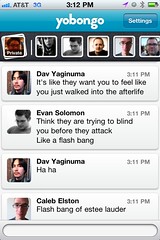
A new group chatting app Yobongo launched recently, just in time for SXSW. It is an iOS app which uses your location to throw you into a simple chat room with other people in the same location. I've been semi-obsessed with it since it launched last week so I thought I'd note down some thoughts about it. Here's its well produced but nauseatingly-hipster intro video:
The reason for my interest is that back in 1999 I was working an a product idea in a similar vein. Instead of pursuing that idea I instead co-founded a chemical informatics company and have spent the years since wondering "what if"? Yobongo has some aspects of that old idea (it was sort of a mashup of Yobongo and GroupMe, another recent group chatting app). More recently, right before SXSW 2010 I started to add similar functionality to my side project app Skedu, but I didn't have time to complete it (and btw subsequently shelved Skedu work until I have time to implement a web-based schedule creator that outputs skedu json and an embeddable schedule HTML5 widget, maybe this year)
Apparently the service manages the number of people in the chat room, such that as the number of people in a region grows they create new chat rooms with a smaller range. For instance when I first signed up there were about 20 people in my chat room. Their locations spanned from Mountain View to Walnut Creek to Santa Rosa, which means about a 20+ miles radius around San Francisco. That was probably everyone using the app at that time right after launch. Supposedly if a more people signed on the radius represented in the subsequently created rooms would be much smaller.
I believe the ideal use case for this app is at events such as music festivals and conferences where a lot of strangers with a temporary shared interest are gathered. I predict it will gain a lot of traction this summer during the music festival season. It is also fun as a random chat room to pass the time. I used it on a Caltrain ride from SF to Palo Alto this weekend and it worked great the whole ride.
I'm sure there are many more changes coming soon in planned updates, but here's a brain dump of my thoughts and feature suggestions so far:
It would be nice if you could bookmark users you've run into for later reference. Additionally you should be able to add tags or notes on the user. Use case: I asked who was going to SXSW and it would have been nice to note the responses in some way within the app.
You should be able to copy text from messages into the iOS clipboard.
Better threaded conversation. Pro tip: if you double tap on a user's message it autostarts a new comment prepended with that user's name. It doesn't seem to link your new message to the old one though. What would be better is for the app to note the reply tree created in this manner. This would then make it possible to add an indicator in the new message that it is a reply. Tapping on the indicator could then temporarily filter out all messages in the chat room that are not part of that thread.
It would be nice if you could then take a thread and email it to yourself for reference.
You can see a brief profile on each user. Showing the approximate location on map in user profile would decrease the noise from the most common message theme: where is everyone? An even nicer touch would be to use a geo lookup to simply put the city name in the profile automatically as well.
To get more into the GroupMe sort of features, I want to be able to create permanent private groups so I can always engage with Yobongo as a back channel for various sets of friends, regardless of our current location.
When entering a message it would be nice to be able to drop in a venue record such that it displays as the venue name, but tapping on the name in the message will bring up venue information. "Hey let's have a flash meetup at [suchnsuch cafe] in 15 minutes!"
I would like to have the option of using the landscape keyboard while typing a note. I know this decreases the amount of space to display the message stream, but I really just want to be able to turn the phone sideways for a few secs so I can type better, then rotate it back for reading the channel.
Here's a big one that will be especially useful at conferences: GameKit support. In the event that you are on a conference wifi network that cannot reach the Interent (too common), ideally Yobongo would still work in a peer to peer mode using iOS GameKit. It might even be possible to pull this off withBlueTooth mode so it could work without any wifi. I was considering making an attempt to do this in the iBurn app for Burning Man a couple of years ago. I like the serendipity aspect of long range delivery being dependent on devices moving in and out of bluetooth range of each other. Hey, possible communication beats no communication!
It needs to support iOS multitasking!
Ability to drop in a photo or video would be fantastic. Ideally these would be thumbnailed by default.
Links to websites should launch safari.
There are some bugs of course. It crashed a few times on me. Once I went into settings and when I came back to the channel a bunch of recent messages had disappeared. Another time I joined a chat room and all of the timestamps on the existing messages were in the future.
All in all I'm excited about Yobongo and I think they've done a great job on initial release. The app is slick and simple which is perfect for an MVP. The use of elegant eye candy like the animation of the thumbnails in the users bar is wonderfully designed. The use of the Address Book on sign up is an underused capability in IOS apps. Congratulations to the Yobongo team! Just please make the hipster videos more palatable ;)
My favorite new product of the past decade, after the iPad and the iPhone, is HeatTech from Japan. It's a new fabric that is comfortable, anti-static and most importantly unusually warm despite being very thin. I love it. Mie's mom introduced her to it back in December and she brought some back for me. Her mom sent another care package of HeatTech recently. I can't get enough. They make undershirts, underwear and socks. Exciting! Seriously, I love this stuff.
After 15 years, my first Internet hosting provider is making some big changes that caused me to go grab my stuff from there. These are some really dusty files....
Update: Wow, I just realized the full extent of these changes. The provider is apparently selling the serve.com domain name, which is the domain of my main email address I've used to sign up for pretty much EVERYTHING on the Interwebs since 1995 until now. This email address will no longer be functional in a few weeks. There is no way I can possibly be sure to update all of my website accounts to use a new address by then, and afterward I won't be able to use the forgot password feature any more. Heck, a lot of sites don't even have a facility for you to change your associated email address. This is going to turn out to be an involuntary abandonment of a lot of accounts.
I shaved a few yaks before I figured this out so hope this saves you some time.
Note that there is a rare but serious bug in CouchDB 1.0.0, so if you install that version read the warning first.
Sometime next week I'm going to send out beta copies of an iPhone app I've been working on. If you'd like to help me out, please send me your iPhone UDID so I can prepare a copy of the app for you (this is required by Apple in order to let people install an app not in the App Store yet).
I would be especially gratefulif you have an event coming up, such as a conference, music festival, or film festival. The application is an event scheduler/viewer. If you have such an event, I'll try to prepare a dataset just for you!
To get the UDID from your iPhone or iPod touch you can follow these instructions or download one of the many free UDID apps from the app store and SMS/email it to me. It would be great if you also let me know what type of device you have and what version of the iPhone OS you are running. It needs to be at least 3.0.